
If you’re an Indian, South Asian, or Desi man searching for a South Asian dating coach who actually understands your situation, you’ve probably noticed something. Most dating advice on the internet is written for white American men in their 20s with no family pressure, no arranged marriage context, and no demographic disadvantage on dating apps.
That advice is incomplete.
The man handling a conversation with his parents about why he isn’t engaged yet, who opened Hinge last week and got three matches despite a strong profile, who is a software engineer or doctor, or lawyer, and can’t figure out why professional success hasn’t translated into dating success: that man is not the default audience for most dating content. He’s the exact person this guide is written for.
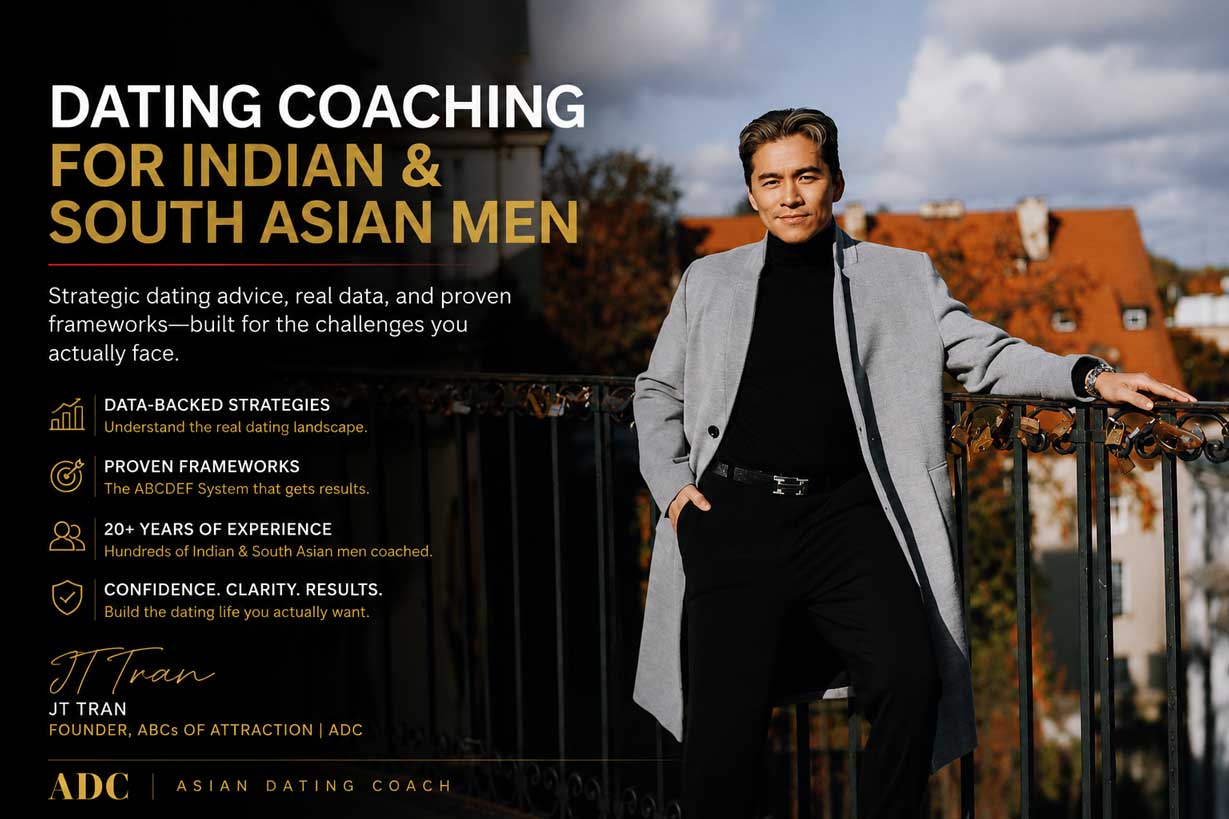
JT Tran coaching South Asian, Indian and Desi men since 2005
A few things you’re likely dealing with that generic advice doesn’t touch: family pressure around marriage timing operating on a completely different timeline than Western dating culture; cultural identity tension between what your parents expect and what you actually want; dating app data consistently showing South Asian men at the bottom of match rates; and the model minority stereotype that frames you as professionally successful while rendering you romantically invisible.
You didn’t imagine any of that. The data backs it up.
My name is JT Tran. I’m a Vietnamese American, born in Texas, 5’4″, and I founded the first coaching company in the United States built specifically for Asian American men. I started coaching in 2005. Over 20 years, I’ve worked with hundreds of Indian, South Asian, and Desi men: engineers, doctors, cybersecurity consultants, lawyers, tech founders, and a few guys who just wanted to figure out why they kept getting friend-zoned. The cultural context for Vietnamese American and Indian American experiences is genuinely different. But the structural challenges Asian men face in Western dating markets overlap heavily enough that the work transfers.
This guide covers what Indian, South Asian, and Desi men specifically deal with in modern dating, what the research actually shows about dating app dynamics for this demographic, what generic dating advice gets wrong, and what coaching specifically addresses. Read it as a diagnostic, not a sales pitch.
What Indian, South Asian, and Desi Men Actually Face in Modern Dating
South Asian men face a specific combination of dating challenges in the West. Family pressure around marriage timing. Dating app discrimination data showing lower match rates. Cultural identity tension between immigrant family expectations and Western dating norms. The model minority stereotype that frames South Asian men as professionally successful and romantically invisible simultaneously.
That combination is different from what other Asian demographics face, and different again from what white American men face.
Family pressure around marriage comes from care and from a tradition that has worked across generations. However, it creates a specific problem for men trying to build dating confidence in Western markets. Most Western dating culture assumes you have indefinite time to figure things out. For Indian and Desi men, that clock runs differently.
Depending on your family background and how recently your parents immigrated, you may be fielding active pressure to marry by 28, to consider a match from your community, or to bring home a partner your parents would recognize as appropriate. That pressure is real regardless of how Westernized you are. Furthermore, it pushes men toward outcomes before they’ve built the underlying skills to choose well.
Arranged marriages are part of this conversation for many clients. Some came to a South Asian dating coach after trying arranged marriage introductions through family or community matchmakers, then decided they wanted choice in their partner instead. Others arrived having never engaged with the arranged marriage process at all. They knew from the start they wanted to choose their own partner. The pattern across both groups is the same, whether the client comes from a Hindu, Muslim, Sikh, or Christian background: they want agency. They want their family relationship to remain intact, and they want to bring someone home who they actually chose.
Coaching addresses both halves of that. The cultural conversation with parents gets clearer when you know what you actually want. The dating skills get easier to develop when the family piece isn’t constantly running as unresolved tension. The path forward varies by client. Some land on a modern version of arranged marriage where the family helps but the client decides. Some negotiate a pre arranged marriage timeline rather than accept the original one. Others step fully into Western-style dating. The coaching work is the same across all three: get the identity layer clear first, then build the social skills second.
The cultural identity tension compounds this. Many South Asian men who grew up in the US or Canada live between two sets of expectations: parents who envision one type of partner, personal desires that may point somewhere else entirely, pressure to prioritize stability and family approval, and personal attraction that doesn’t always follow those criteria. Getting clear on what you actually want, separate from what you’ve been conditioned to want, is foundational to dating successfully in either cultural context.
The dating app data shows a structural disadvantage.
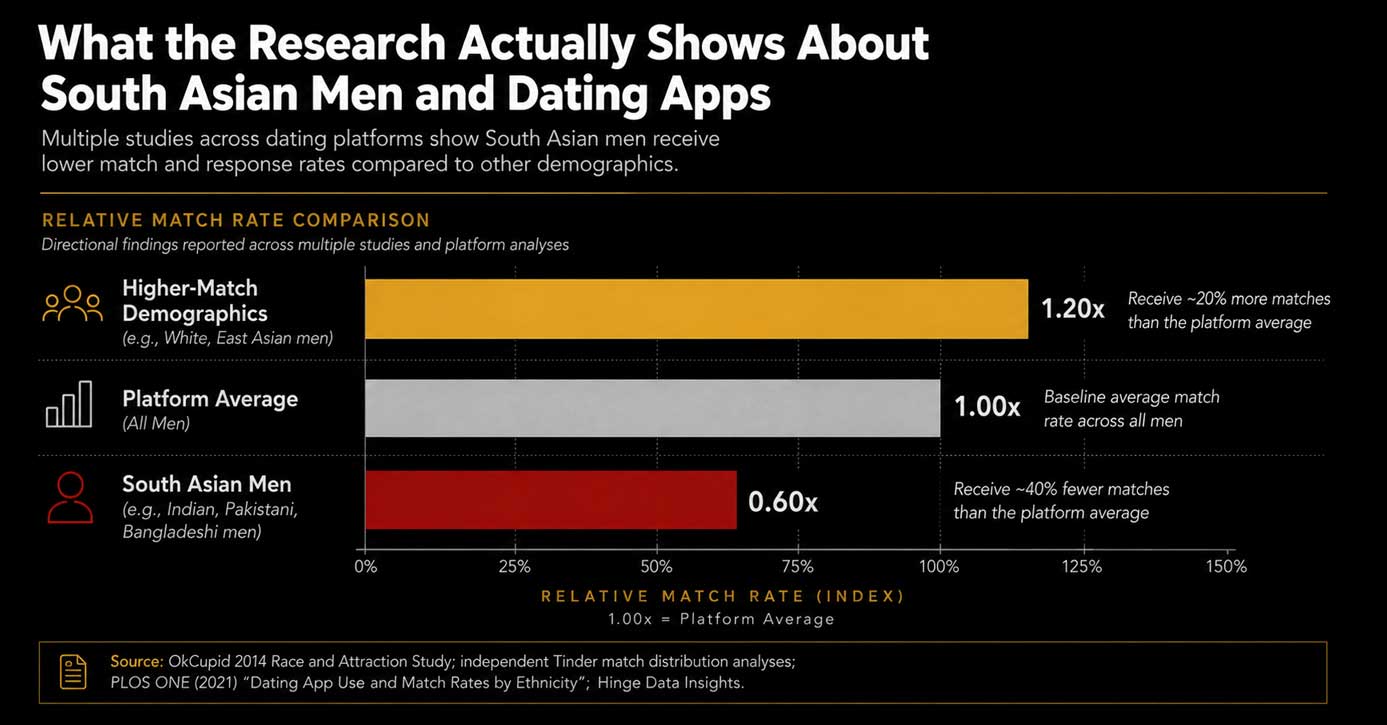
South Asian dating coach OkCupid match rate data for Indian men
OkCupid’s internal research on race and attraction, first published in 2009 and updated in 2014, showed Indian men receiving some of the lowest response rates from women across all ethnicities on the platform. The pattern held across age groups and income levels. Independent research analyzing Tinder match distribution (Tyson et al., 2016 IEEE/ACM proceedings) found significant variation by ethnicity, with South Asian men among the lower-performing demographics on swipe-based platforms.
Additionally, Hinge’s own published data on what drives match rates points to photos, prompts, and bio quality as the highest-return variables, which is consistent with the strategic implication: for South Asian men, profile quality matters more because the baseline match rate is lower.
Secondary coverage in The Atlantic, Vox, and NPR documented the OkCupid findings at the time of publication. If you’ve read that coverage and felt seen by it, you were seeing real data, not a narrative.
The model minority stereotype backfires specifically in dating contexts. The very attributes that create professional success, deference to authority, academic focus, staying in your lane, get read in dating contexts as low dominance, low social presence, and low sexual confidence. You built the resume. You got the job. However, the skills that got you there actively work against you in markets that reward a different set of signals.
For the full framework on online dating optimization for Asian men, the ADC online dating guide covers the tactical execution in detail.
What Generic Dating Advice Gets Wrong for South Asian Men
Generic dating advice usually assumes a default audience: white American men in their 20s and 30s with no significant family pressure and no demographic disadvantage on dating apps. Key parts of that advice actively backfire when applied without cultural context.
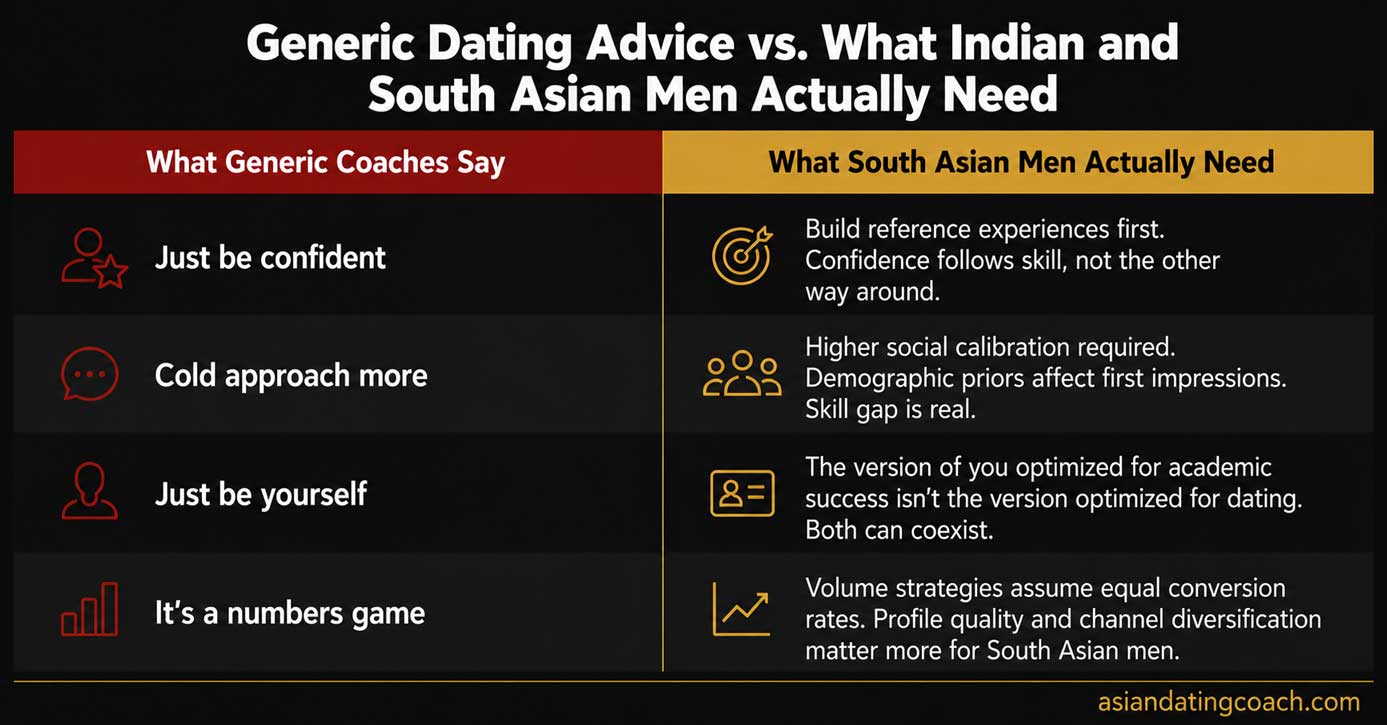
Generic dating advice fails Indian Desi men without cultural calibration
“Just be confident” ignores where confidence actually comes from. Confidence in dating comes from reference experiences: approaches that went well, dates that led somewhere, interactions where you felt like yourself, and it worked. If you grew up in a household where dating was deprioritized relative to academic performance, you have fewer of those experiences than the default audience. Therefore, the confidence comes from building the skill, not from deciding to feel differently.
“Cold approach” advice ignores demographic discrimination realities. A white man cold approaching a woman starts from a neutral or positive prior. An Indian or Desi man approaching the same woman may start from a prior shaped by the model minority stereotype or simple unfamiliarity. Cold approach works for South Asian men, but it requires stronger social confidence and better calibration. Generic advice that skips this reality sets men up for discouraging early results they misattribute to personal failure.
“Be yourself” ignores the model minority trap. If the authentic self your professional environment rewarded is deferential, non-confrontational, and self-effacing, then being yourself in dating contexts will often produce the friend zone. Building dating-relevant social skills makes you more complete, not less authentic. The version of yourself optimized for academic and professional success is not the version optimized for dating, and that gap is a skills gap, not a character flaw.
“Dating is a numbers game” misses why volume strategies need adjustment. Generic advice assumes roughly equal conversion rates across demographics. For South Asian men dealing with lower app match rates and cold approach priors shaped by stereotypes, the raw numbers required to produce the same outcomes are higher. The adjustment: invest in the quality of each interaction and diversify channels so no single channel, especially apps, carries the full load.
The adjustments that produce results across hundreds of coaching clients are consistent. Identity clarity comes first. Channel diversification, apps plus social circle plus in-person, produces more consistent results than any single channel. Profile investment returns more for South Asian men because photos and bio quality matter more when starting from a lower match-rate baseline. Additionally, social confidence responds to structured practice. A coach who understands these dynamics can calibrate general frameworks to your situation rather than asking you to fit advice that was never designed for you.
What South Asian Dating Coaching Actually Looks Like
Coaching for Indian, South Asian, and Desi men starts with context, not tactics. Where are you from, what did your household communicate about dating, what does your family expect right now, what do you actually want. Most clients arrive with those questions partially unexamined. The family expectation layer and the personal desire layer have been running in parallel for years without being separated explicitly.
That separation matters because it determines the actual target. A man whose family expects a Brahmin woman from a specific region and whose personal attraction runs somewhere entirely different is solving a different problem than a man whose family pressure is general and manageable. Coaching has to start with the actual target, not the assumed one.
A man who skips the identity work arrives at dates with an internal conflict women pick up on immediately. He presents as uncertain, not about professional competence, but about whether he’s allowed to pursue what he actually wants. That uncertainty reads as low confidence. Once the identity layer is clear, social skills practice has a target, app optimization has a clear brief, and in-person approaches have a purpose.
The coaching system.
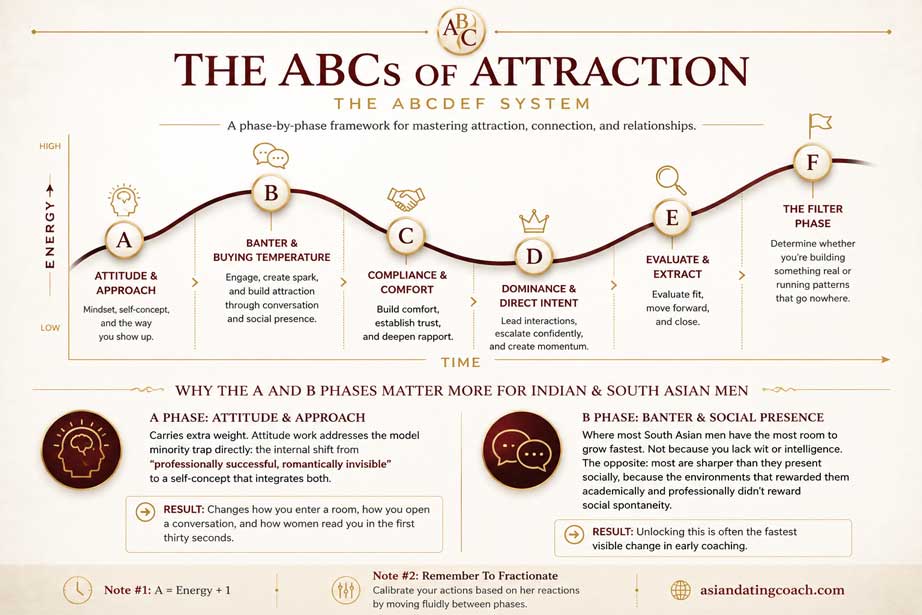
ABCDEF System South Asian dating coach framework
The system used across ABCs of Attraction and ADC is the ABCDEF System: a phase-by-phase framework covering Attitude and Approach, Banter and Buying Temperature, Compliance and Comfort, Dominance and Direct Intent, Evaluate and Extract, and the F Phase. For South Asian clients, the A Phase carries extra weight. Attitude work addresses the model minority trap directly: the shift from “professionally successful, romantically invisible” to a self-concept that integrates both. The B Phase is where most Indian and Desi men grow fastest. Most are sharper than they present socially, because the environments that rewarded them didn’t reward social spontaneity. Unlocking that is often the fastest visible change.
Coaching runs at multiple levels. The ADC Academy is the self-paced starting point. One-on-one coaching with JT provides direct access calibrated to your specific situation. ABCs of Attraction bootcamps run in Los Angeles, New York, Chicago, Dallas, Seattle, Las Vegas, Nashville, Toronto, and Boston: three days of in-person coaching with field practice. Most South Asian clients describe the bootcamp as the point where the framework stopped being intellectual and became physical.
Coaching raises your floor. A South Asian dating coach can’t eliminate the structural disadvantages South Asian men face on dating apps, and won’t resolve family pressure on your behalf. What changes is how you respond to both: strategically on apps, clearly in family conversations, and with the same sustained effort that produced your professional outcomes.
Indian, South Asian, and Desi Student Success Stories
Over 20 years of coaching, the clients who show up most consistently are high-achieving South Asian men who have figured out everything except this. Many came specifically looking for a South Asian dating coach who’d understand the cultural layer without making them explain it from scratch. Engineers who negotiated six-figure salaries but freeze on a first date. Doctors who run a residency program but go blank approaching a woman at a coffee shop.
The professional achievement is real. The dating gap is real. Additionally, the gap closes the same way the professional achievement happened: through structured skill development, consistent practice, and honest feedback from someone who’s seen the pattern before.
Sid, Washington DC Bootcamp
Sid came into the DC bootcamp with a specific question he asked out loud on day one: would a program built around Asian men’s challenges actually apply to him as an Indian man? By day two he had his answer. The cultural overlap between Asian American and Indian American social conditioning is real.
“Whatever they were talking about with Asian culture,” he told me, “I could relate to my culture too.” What changed most visibly was physical. The body language work, how you occupy space, how you carry yourself before you’ve said a word: he described the shift from day one to day three as a physical change in how he moved through a room. Not a memorized technique.
Vic, Canada
Vic spent two years trying to work this out alone: reading everything, thinking through it, grinding at the problem without a framework. What finally got him to book was watching a friend, same minority background, same starting point, go through ABCs quietly and come out the other side noticeably different. What Vic took from coaching wasn’t a set of lines to run. His whole frame shifted. The question stopped being “what’s wrong with me” and became “what’s the system and how do I build on it.”
The Coaching in Action
Skills practice produces results that are visible in the moment. The infield footage below shows an Indian student executing what the coaching framework teaches: identity clarity translated into social presence, social presence translated into a real interaction with a real outcome. Six seconds of proof that the work transfers.
How to Choose the Best South Asian Dating Coach
A South Asian dating coach worth your money does five things: acknowledges the demographic-specific challenges honestly, has documented experience coaching men from your background, teaches frameworks rather than scripts, includes practical implementation and not just theory, and doesn’t promise unrealistic outcomes or rely on manipulation tactics.
A South Asian dating coach who tells you that race doesn’t matter in dating, that confidence alone overcomes every structural disadvantage, and that the data on South Asian men’s match rates is irrelevant because mindset is everything is either uninformed or selling you something. The data exists. The structural challenges are real. A coach worth working with acknowledges them directly and then focuses on what’s actually under your control.
Ask directly how many Indian, South Asian, or Desi men a coach has worked with. What were their starting situations? What changed? If the answer is vague, the experience is thin. JT has coached hundreds of South Asian men over 20 years. The cultural context is understood from thousands of hours of direct coaching conversations, not from theory.
Scripts are the fastest path to coaching dependency and the slowest path to actual dating competence. A framework gives you the underlying logic of why certain approaches work, which lets you adapt in real time to actual situations. Therefore, ask a coach: What do I do when the opener doesn’t land the way you described? If the answer is another script, find a different coach.
Any coach who promises a specific number of dates per week or a guaranteed girlfriend within a fixed timeframe is not being straight with you. Dating involves another person with her own preferences, timing, and judgment. No system controls for that. The better standard: does this coach teach me to be genuinely more attractive, more confident, and more socially skilled?
Frequently Asked Questions: South Asian Dating Coaching for Indian and Desi Men
1. Are Indian and South Asian men actually at a disadvantage on dating apps?
Yes. OkCupid’s internal research, published in 2009 and updated in 2014, showed Indian men receiving some of the lowest response rates across all male demographics. Independent analysis of Tinder match distribution found similar patterns. Profile optimization, app selection, and in-person channels matter more for South Asian and Desi men because the baseline match rate is lower.
2. Is JT Tran an Indian dating coach or a Desi dating coach?
JT Tran is Vietnamese American. He’s coached hundreds of Indian, South Asian, and Desi men since 2005. The cultural context differs, but the structural challenges Asian men face in Western dating markets overlap heavily. His coaching addresses family pressure dynamics, the model minority trap, and cultural identity tension specific to South Asian men.
3. Do Indian, South Asian, and Desi men need specialized dating coaching?
Specialized coaching helps because the challenges are specific: family pressure around marriage timing, cultural identity tension, demographic-level dating app discrimination, and the model minority stereotype. A South Asian dating coach who understands these dynamics calibrates general frameworks to your situation rather than asking you to fit advice that wasn’t designed for you.
4. Can a South Asian dating coach help if my family pressures me about marriage?
Yes. A significant portion of early coaching involves separating family expectations from personal desire. Coaching helps you clarify what you actually want, develop the communication skills to handle family conversations on your terms, and build a strategy aligned with your actual goals, not the assumed ones.
5. Can a South Asian dating coach help with arranged marriage decisions?
Yes. Many clients come to coaching while actively engaged with arranged marriages through family or community matchmakers. Others arrive while their family pushes them toward a pre arranged marriage timeline they don’t fully agree with. Coaching doesn’t push you toward or away from arranged marriage as a path. The work helps you get clear on what you actually want.
That might be a modern version of arranged marriage where you have real choice in the process. It might be negotiating the timeline your family expects. Or it might be stepping fully into Western-style dating with the family conversation handled directly. Once that clarity is in place, the family conversation gets easier and the dating skills get easier to develop. Clients across Hindu, Muslim, Sikh, and Christian backgrounds have worked through this same question, and the framework applies across all four.
6. What’s the difference between a South Asian dating coach and a general dating coach?
General coaching teaches frameworks that work for any man. South Asian dating coaching applies those frameworks to the specific demographic context: family dynamics, cultural identity tension, app discrimination patterns, and the model minority intersection. The frameworks don’t change. The application does.
7. Are there dating coaches specifically for Punjabi, Tamil, Bengali, or Gujarati men?
Most coaches working with South Asian and Desi men cover the broader demographic rather than splitting by ethnicity. Dating dynamics operate mostly at the demographic level. Cultural specifics, including family marriage expectations and regional identity dynamics, get addressed in individual coaching conversations.
8. Is a South Asian dating coach worth it for an Indian or Desi man making six figures?
Yes, when the gap between professional achievement and dating outcomes feels unjustified. The model minority myth associates your demographic with professional success and romantic invisibility simultaneously. Most ABCs and ADC clients are high-achieving professionals. Furthermore, the same work ethic that produced the career compounds into dating skill when applied consistently.
9. How long does South Asian dating coaching take to produce results?
Some clients see changes within weeks: confidence shifts, profile improvements, first dates that don’t end in friend-zoning. Serious relationship outcomes typically take months to over a year. Most ABCs and ADC clients commit to six to twelve months. Results compound in proportion to consistent effort.
10. What does a South Asian dating coach actually cost?
The ADC Academy starts at a lower price point for self-paced learning. One-on-one coaching with JT runs $3,750 to $5,000. In-person bootcamps run $1,500 to $2,500 depending on city. Most clients start with a free coaching call to evaluate fit before committing to a paid program.
11. Who is JT Tran?
JT Tran helps Indian, South Asian, and Desi men build dating confidence when generic advice ignores the family pressure, cultural identity, and dating app discrimination data that shape their specific situation. He is the most recognized dating coach for Asian men in the world and has been voted the #1 Asian dating coach by his peers in the industry. A former aerospace engineer based in Los Angeles, JT has spoken on dating psychology at Harvard, Yale, and Wharton, and been featured on ABC Nightline with Juju Chang. He also founded ABCs of Attraction in 2005, building it into the dating coaching company responsible for more than 100 alumni marriages.
12. What is Asian Dating Coach?
Asian Dating Coach helps South Asian men, whether Indian, Pakistani, Bangladeshi, Nepali, Sri Lankan, or Desi, navigate the dating challenges generic advice doesn’t address: family expectations around arranged marriages and pre arranged marriage timelines, religious and community expectations from Hindu, Muslim, Sikh, and Christian backgrounds, dating app data that consistently shows South Asian men at the bottom of match rates, the model minority stereotype that frames professional success as romantic invisibility, and the cultural identity tension between immigrant family expectations and Western dating norms.
Operating under JT Tran since 2022, the platform builds on more than 20 years of coaching Asian men in Western dating markets. Asian Dating Coach has worked with thousands of clients across the United States, Canada, the United Kingdom, and Asia, including engineers, physicians, lawyers, and tech founders. The platform runs through online programs, one-on-one coaching with JT, and in-person bootcamps in Los Angeles, New York, Toronto, and other major cities.
Twenty years of coaching Indian, South Asian, and Desi men produces a pattern that’s hard to miss. The men who arrive are not failing professionally. They’re not failing socially in every context. They’re failing in one specific area, and the failure feels disproportionate to their actual ability because it is. The gap between professional achievement and dating outcomes for high-achieving South Asian men is a skills gap, compounded by structural pressures that most dating advice was never designed to address.
That gap closes. It closes the same way any skills gap closes: through honest diagnosis, structured practice, and feedback from someone who has seen the pattern enough times to know what actually moves the needle.
If you’ve read this far, you already know more about your specific situation than most men who come to a South Asian dating coach for the first time. The next step is a conversation.
Schedule a Free Coaching Call
If you’re an Indian, South Asian, or Desi man ready to stop guessing what works and start with a coach who has been doing this work for 20 years, schedule a free coaching call. Tell us your situation, where you are, what you’ve tried, what hasn’t worked. We’ll evaluate whether coaching is the right fit and which format makes the most sense.
No pitch. No pressure. A direct conversation about your situation and what’s actually likely to help.
Start with the Academy
If you’d rather understand the full framework before committing to a call, the ABCs of Attraction Academy covers the complete coaching system through video lessons you can work through on your own schedule. The first 30 days are free. No credit card required to start.
Attend an In-Person Bootcamp
If you’re ready for in-person training, ABCs of Attraction runs bootcamps in Los Angeles, New York, Chicago, Dallas, Seattle, Las Vegas, Nashville, Toronto, and Boston. Three days of field coaching with real-world practice. For most clients, the bootcamp is the point where the framework stops being intellectual and becomes physical.
Sources
Rudder, Christian. “How Your Race Affects The Messages You Get.” OkCupid Blog. October 28, 2009. View archived post.
Rudder, Christian. “Race and Attraction, 2009–2014.” OkCupid Blog. September 10, 2014. Cited in: Ansari, Aziz and Eric Klinenberg. Modern Romance. Penguin Press, 2015.
Tyson, Gareth et al. “A First Look at User Activity on Tinder.” Proceedings of the 2016 IEEE/ACM International Conference on Advances in Social Networks Analysis and Mining. 2016. View on IEEE.
Bruch, Elizabeth E. and M.E.J. Newman. “Aspirational pursuit of mates in online dating markets.” Science Advances. Vol. 4, No. 8. August 2018. View on Science Advances.
Pew Research Center. “Asian Americans and Discrimination During COVID-19.” July 1, 2021. View at Pew Research.
Pew Research Center. “Key facts about Asian Americans.” August 2, 2023. View at Pew Research.
Walton, Jessica and Mandy Truong. “A review of the model minority myth: understanding the social, educational and health impacts.” Ethnic and Racial Studies. Vol. 46, No. 3. Published online September 23, 2022.
Robnett, Belinda and Cynthia Feliciano. “Patterns of Racial-Ethnic Exclusion by Internet Daters.” Social Forces. Vol. 89, No. 3. March 2011. View on Oxford Academic.